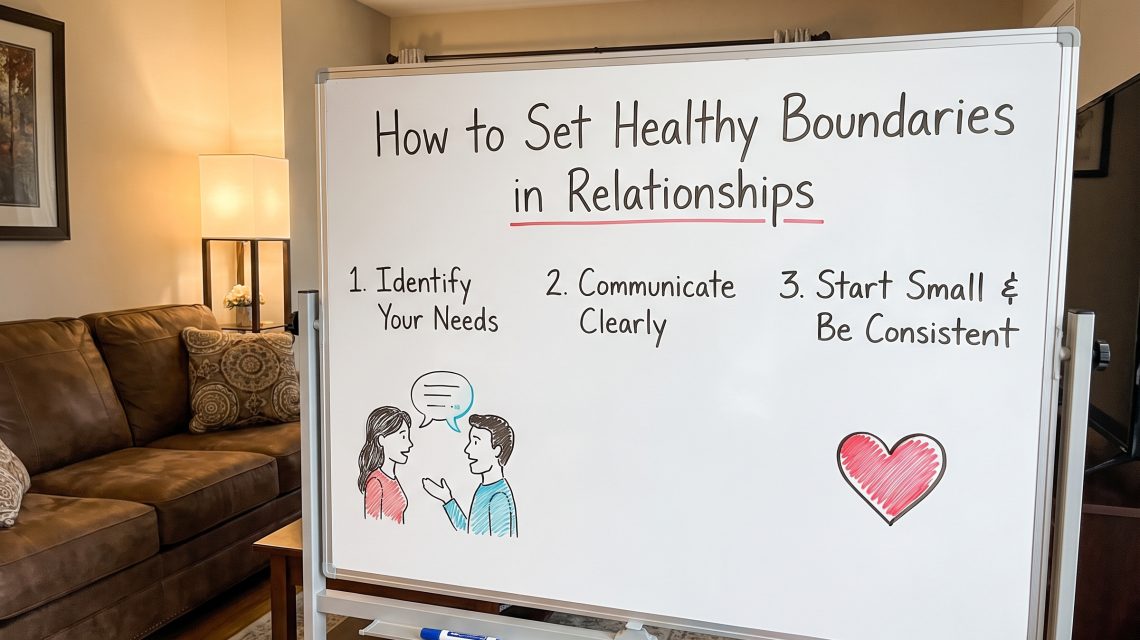
Do you find yourself saying yes when you mean no, feeling resentful after helping others, or exhausted after spending time with certain people? These are common signs of weak or unclear boundaries. Boundaries are not walls meant to keep people out — they’re guidelines that protect your time, energy, and emotional well-being while still allowing for close, healthy relationships.

What Are Boundaries, Exactly?
A boundary is a limit you set on what you will and won’t accept from others — in terms of time, energy, communication, or behavior. Healthy boundaries aren’t about controlling other people; they’re about clearly communicating your own needs and consistently honoring them yourself.
Signs You May Need Stronger Boundaries
- You frequently feel resentful, drained, or taken advantage of
- You say yes automatically, then regret it later
- You avoid certain people because interactions feel exhausting
- You struggle to identify your own needs in a relationship
- You feel responsible for managing other people’s emotions
How to Set Boundaries Without Guilt
1. Get Clear on What You Actually Need
Before you can communicate a boundary, you need to know what it is. Notice situations that consistently leave you feeling drained or resentful — these are strong clues about where a boundary is missing.
2. Use Direct, Simple Language
Boundaries don’t need lengthy justifications. “I can’t take that on right now” or “I need some time to think before I answer” are complete sentences. Over-explaining often invites negotiation.
3. Expect Some Discomfort — Yours and Theirs
People who are used to you saying yes may push back when you start setting limits. This discomfort is often temporary and doesn’t mean the boundary is wrong; it usually means it’s working.
4. Be Consistent
A boundary you enforce sometimes and drop other times sends a mixed message. Consistency, even in small moments, is what makes a boundary credible over time.
5. Practice Self-Compassion Along the Way
Setting boundaries, especially with people you love, can bring up guilt. Working on your inner dialogue can help you hold the line without spiraling into self-criticism.

Boundaries in Different Relationships
Boundaries look different across contexts — a boundary with a coworker might involve response times to messages, while a boundary with a parent might involve how personal topics are discussed. In all cases, the underlying principle stays the same: your needs are valid, and communicating them clearly is a form of respect, both for yourself and for the relationship.
When Boundaries Feel Especially Hard
If you grew up in an environment where your needs were dismissed, boundary-setting can feel unfamiliar or even frightening at first. This is common, and it often improves with practice and, when needed, support from a therapist. Building the emotional resilience discussed in our article on emotional resilience can make it easier to hold boundaries even when they feel uncomfortable.

A Skill Worth Building
Healthy boundaries aren’t selfish — they’re what allow relationships to be sustainable rather than draining. Like any skill, boundary-setting improves with practice, and every small, honest “no” makes the next one a little easier.